How to Play Shogi
Chess from Japan: what you take, you may drop back into the fight.
Shogi is the chess of Japan, on a nine-by-nine board with twenty pieces a side, and the rule that makes it unlike any other chess: a piece you capture becomes yours, and on a later turn you may drop it back onto the board, facing the other way. Most pieces promote when they reach the far three ranks, the king is attacked from every direction by pieces that never run out, and there is no stalemate — a player with no legal move has lost. Play it offline against the computer at three levels, or online on a clock, on the materials of the eight boards.
Ways to play Shogi
Against the computer
Pick your side and a level — Easy, Medium or Hard — and play Shogi offline. The game is kept in your browser, exactly where you left it.
Online, on a clock
Create a board, choose your color, set a clock from one minute to sixty — or none at all — and share the code. Only the side to move has their clock running.
In 2D or 3D
Lay the board flat or stand it up. Every piece rises onto its square, and you can flip between them mid-game.
Seven boards, seven sets
Classic felt, Renaissance marble, Stone Age sandstone, Ice Age glacier, Jurassic amber, a Crustacean tide pool and a medieval chamber — changed while you play.
🎯 Objective
Checkmate the other king. A player with no legal move has lost; a repetition is a draw unless one side gave perpetual check; and once your king has broken into the enemy camp, points can decide the game.
🎲 Shogi setup
- The board is nine squares by nine, unchequered. The pieces are flat pentagons marked with kanji, each pointing at the player’s opponent; a captured piece is turned round to face its new owner’s way.
- The back rank, from the left: lance, knight, silver, gold, king, gold, silver, knight, lance. On the second rank the bishop stands on the left and the rook on the right, with seven empty squares between them. Nine pawns fill the third rank.
- Each player has a hand — the pieces they have captured — shown beside the board.
- Choose your side and the engine’s level — Easy, Medium or Hard — or create an online board and set the clock. Sente (Black) moves first.
▶ How to play Shogi
- A pawn (歩) moves and captures one square straight ahead. A lance (香) slides any distance straight ahead. A knight (桂) jumps two forward and one across, over anything in the way — forward only.
- A silver (銀) steps one square forward or diagonally in any direction. A gold (金) steps one square in any direction except diagonally backward.
- The rook (飛) slides along ranks and files, the bishop (角) along diagonals, and the king (王/玉) one square in any direction.
- A piece that moves into, within or out of the far three ranks may promote, and must when it could never move again — a pawn or lance on the last rank, a knight on the last two. A promoted rook (龍) also steps one square diagonally, a promoted bishop (馬) also steps one square straight, and a promoted silver, knight, lance or pawn (と) moves as a gold. Golds and kings do not promote.
- A piece you capture goes to your hand, unpromoted. Instead of moving, you may drop a piece from your hand onto any empty square, facing your opponent.
- Three drop rules: a piece may not be dropped where it could never move; a pawn may not be dropped on a file that already has one of your unpromoted pawns (nifu); and a pawn may not be dropped to give checkmate (uchifuzume). A dropped piece is never promoted on arrival.
- A king in check must get out of it at once — by moving, by capturing the attacker, or by blocking the line with a move or a drop.
- To move, tap a piece and then the square; when promotion is your choice, the app asks. To drop, tap a piece in your hand to see where it may land, then tap the square.
🎬 Watch: How to Play Shogi
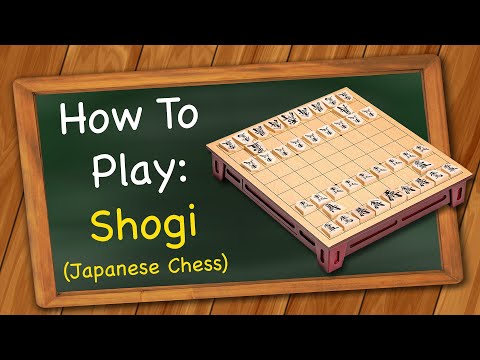
This video is embedded from YouTube and remains the intellectual property of its respective creator and/or rights holder. Vanikar LLC claims no ownership of, or rights in, the video content, and no affiliation with or endorsement by its creator is implied. The video is displayed via YouTube’s public embed feature in accordance with the YouTube Terms of Service and the agreements between YouTube and the content uploader.
📖 Detailed guide
The pieces, and how they promote
- King (王/玉) — one square in any direction. Rook (飛) — ranks and files; promoted to dragon (龍), it also steps one square diagonally. Bishop (角) — diagonals; promoted to horse (馬), it also steps one square straight.
- Gold (金) — one square any way but diagonally back; it never promotes. Silver (銀) — one square forward or diagonally; promoted, it moves as a gold.
- Knight (桂) — two forward and one across, jumping, forward only. Lance (香) — any distance straight ahead. Pawn (歩) — one square ahead, and it captures the same way. All three move as a gold once promoted; a promoted pawn is the tokin (と).
- Promotion is a choice on any move that starts or ends in the far three ranks, and compulsory when the piece could never move again. A promoted piece that is captured goes to the hand unpromoted.
Drops
- A captured piece is yours. On any later turn you may drop it on any empty square instead of moving — that is the whole move.
- Nifu: never a second unpromoted pawn of yours on the same file. A promoted pawn does not count.
- Uchifuzume: a pawn may not be dropped to give checkmate. A pawn may give check by a drop, and any other piece may mate by a drop.
- A piece may not be dropped where it could never move again: no pawn or lance on the last rank, no knight on the last two.
How a game ends
- Checkmate, or no legal move at all — both are a loss for the side to move. There is no stalemate draw.
- Sennichite: the same position, with the same hands and the same side to move, for a fourth time is a draw — unless every move of one side since the position first stood was a check, in which case the side giving perpetual check loses.
- Impasse (the 27-point rule): at the start of your turn, your king in the far three ranks, at least ten more of your pieces there, no check on you, and those pieces plus your hand worth 28 points as Black or 27 as White — rook or bishop 5, anything else 1 — wins. The app applies this on its own; there is no declaration, no agreement, and the other king’s position does not matter.
- On a timed board, a clock that runs out loses.
Offline, online and the clock
- Offline you pick your side and the engine’s level. The game is kept in your browser until you end it, and Undo takes back your move and the engine’s reply.
- Online you create a shogi board, choose Sente, Gote or a random draw, set a clock from one to sixty minutes — or none — and share the code or an invite link. There is no byoyomi; the clock is the chess clock.
- Only the clock of the side to move runs. A clock that runs out loses the game.
- The board uses the materials of the eight chess boards, in 2D or tilted into 3D; the pieces are the traditional kanji, turned to face your opponent’s way for theirs. Shogi is rated and recorded as its own game.
🏁 How Shogi is won
Checkmate wins, and so does leaving the other side with no legal move — there is no stalemate in shogi. The same position — board, hands and side to move — for a fourth time is a draw (sennichite), unless one side gave check with every one of its moves since the position first stood, and then that side has lost. Impasse: if your turn begins with your king in the far three ranks, at least ten more of your pieces there, and no check on you, you win if those pieces and your hand are worth 28 points as Black or 27 as White — a rook or bishop 5, any other piece 1. The app judges this itself. On a timed board, a player whose clock runs out loses.
❓ Shogi — frequently asked questions
How many players do you need for Shogi?
Shogi is played by 2. Seats you do not fill are taken by the computer, so a game always starts.
Where can I play Shogi?
In your browser at play.vanikar.games, on a computer, a tablet or a phone. Sign in with the same Vanikar™ account you use for the card games.
Is Shogi included in my subscription?
Yes. One Card Games by Vanikar™ subscription covers the card games, Chess & Checkers and the board games, and every game released after them.
Does Shogi have ads?
No. No Vanikar™ game has ever carried advertising, and none ever will.
How is shogi different from chess?
The board is 9×9 with 20 pieces a side, most pieces promote in the far 3 ranks, and a piece you capture becomes yours to drop back onto the board on a later turn. There is no stalemate: a player with no legal move has lost.
What are the drop rules in shogi?
Three. A piece may not be dropped where it could never move again; a pawn may not be dropped on a file that already has one of your unpromoted pawns; and a pawn may not be dropped to give checkmate. A dropped piece arrives unpromoted and may promote on a later move.
What is the impasse rule, and does the app use it?
When your turn begins with your king in the far 3 ranks, at least 10 more of your pieces there and no check on you, you win if those pieces and your hand are worth 28 points as Black or 27 as White — a rook or bishop counts 5, any other piece 1. The app applies the rule itself at the start of a turn; nobody declares or agrees.
Is shogi included in my subscription?
Yes. Shogi is part of Chess & Checkers by Vanikar™, which a Card Games by Vanikar™ subscription includes. Play it in your browser at play.vanikar.games with the same account.