How to Play Reversi
Outflank a line and the whole line turns yours: the most discs on a full board wins.
Reversi — the game sold as Othello — is played on a green board of sixty-four squares with discs black on one face and white on the other. Place a disc so that a line of the other color is caught between it and one of yours, and every disc in that line turns over. The board fills in sixty moves, and whoever shows more discs at the end wins. Play Black or White against the computer at three levels, or online against another player.
Ways to play Reversi
Two to four at the board
Play Reversi against the computer with one, two or three others at the board. Every seat is filled, so a game always starts.
Online with friends and family
Create a board, share the code, and play together on the same board. Online games count towards your rating and My Stats.
Picked up where you left it
Close the tab mid-game and come back to it — the game is kept in your browser, on the board you were playing.
No ads, ever
No advertising, no interruption, nothing to dismiss. The same promise as every Vanikar™ game.
🎯 Objective
Have more discs showing your color than the other side when the board is full or nobody can move.
🎲 Reversi setup
- The board is eight by eight — sixty-four squares, lettered a to h across and numbered 1 to 8 down.
- Two discs of each color start crossed in the middle: white on d4 and e5, black on e4 and d5.
- You choose Black, which moves first, or White; the computer takes the other at the level you set.
- Every disc is black on one face and white on the other, and there are enough to fill the board.
▶ How to play Reversi
- Tap an empty square from which a straight line of the other color — along a row, a column or a diagonal — runs to a disc of yours. The squares you may play are marked.
- Every disc in that line turns over to your color. A move must turn at least one disc.
- A disc that outflanks lines in several directions at once turns all of them.
- Only the discs between your new disc and your own are turned — nothing beyond, and nothing turned over on the way is used to turn more.
- If no square would turn anything, your turn is skipped and the other side plays again. You may not pass while you have a move.
- The game ends when the board is full, when neither side has a move, or when a side has no discs left.
🎬 Watch: How to Play Reversi
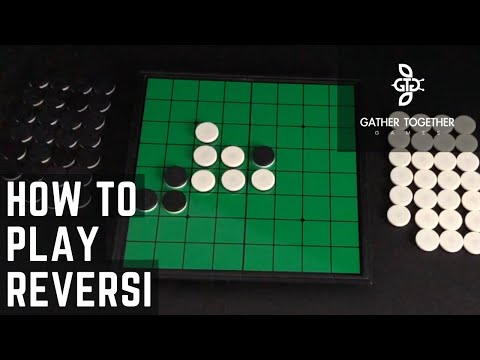
This video is embedded from YouTube and remains the intellectual property of its respective creator and/or rights holder. Vanikar LLC claims no ownership of, or rights in, the video content, and no affiliation with or endorsement by its creator is implied. The video is displayed via YouTube’s public embed feature in accordance with the YouTube Terms of Service and the agreements between YouTube and the content uploader.
📖 Detailed guide
The board
- Sixty-four green squares, a to h and 1 to 8, with the four middle discs crossed: white on d4 and e5, black on e4 and d5.
- Black moves first. The squares where you can legally play are marked on the board.
- Until the next move a ring marks the square last played and a red dot each disc it turned.
- Every move — yours, the computer’s or another player’s — is shown as it is made: the disc is set down, then the discs it outflanks turn over a line at a time. The Animation speed setting makes it quicker.
Outflanking
- A legal move is an empty square from which a straight line of enemy discs runs, unbroken, to a disc of yours — in any of the eight directions.
- All the discs in every such line turn over. A move that would turn nothing is not a move.
- Discs turned this move do not turn others: only the lines from the square you played count.
- There is no capture and no removal. Discs change color, and never leave the board.
Passing and the end
- With no legal move your turn is skipped by itself and the other side plays again; you may not pass by choice.
- The game ends with the board full, with neither side able to move, or with one side wiped out.
- The most discs wins; thirty-two each is a draw.
- A game is its moves: the same sequence replays the same game, which is how it is kept between visits.
Playing well
- Corners cannot be turned. Take them when they are offered, and never give them away for a few discs.
- The squares diagonally inside each corner, and the ones beside each corner on the edge, are the dangerous ones early on.
- Mobility over material: in the opening and middle game, having more moves available matters more than having more discs.
- At the end, try to make the last move in each empty region, so the final turns are yours.
🏁 How Reversi is won
Whoever shows more discs when the game ends wins; the same number is a draw. A side wiped off the board has lost. There is no other score: sixty-four squares, and the count of each color at the end.
❓ Reversi — frequently asked questions
How many players do you need for Reversi?
Reversi is played by 2. Seats you do not fill are taken by the computer, so a game always starts.
Where can I play Reversi?
In your browser at play.vanikar.games, on a computer, a tablet or a phone. Sign in with the same Vanikar™ account you use for the card games.
Is Reversi included in my subscription?
Yes. One Card Games by Vanikar™ subscription covers the card games, Chess & Checkers and the board games, and every game released after them.
Does Reversi have ads?
No. No Vanikar™ game has ever carried advertising, and none ever will.
Is Reversi the same as Othello?
The rules played here are Othello’s: the 4 middle discs set out crossed, Black first, a forced pass when you cannot move, and the most discs on the board at the end. Othello is a trademark; Reversi is the older name of the game.
What happens if I have no move in Reversi?
Your turn is skipped and the other side plays again. You may not pass while you have a legal move, and if neither side can move the game ends and the discs are counted.
Do turned discs turn more discs?
No. Only the lines running from the square you just played are turned. Discs flipped by this move do not start new lines.
How does Reversi end?
When the board is full, when neither side has a move, or when a side has no discs left. The side showing more discs wins; the same number is a draw.