How to Play Chess960
Chess with the back rank shuffled — one of 960 starts, the same for both sides.
Chess960 is chess with no opening book: before every game the eight pieces of the back rank are drawn into one of 960 arrangements — the bishops on opposite colors, the king somewhere between the two rooks — and both sides get the same one. The pawns stand where they always do, every piece moves as it does in chess, and the only rule that needs a second look is castling. Play it offline against the computer at three levels, or online on a clock, on any of the eight boards.
Ways to play Chess960
Against the computer
Pick your side and a level — Easy, Medium or Hard — and play Chess960 offline. The game is kept in your browser, exactly where you left it.
Online, on a clock
Create a board, choose your color, set a clock from one minute to sixty — or none at all — and share the code. Only the side to move has their clock running.
In 2D or 3D
Lay the board flat or stand it up. Every piece rises onto its square, and you can flip between them mid-game.
Seven boards, seven sets
Classic felt, Renaissance marble, Stone Age sandstone, Ice Age glacier, Jurassic amber, a Crustacean tide pool and a medieval chamber — changed while you play.
🎯 Objective
Checkmate the other king, as in chess. Stalemate, threefold repetition and the fifty-move rule are draws; on a timed board, a flag that falls loses.
🎲 Chess960 setup
- The board is eight by eight, set like a chessboard, with a light square in each player’s right-hand corner.
- The app draws a back rank from the 960: bishops on opposite colors, the king between the rooks, queen and knights wherever they fall. Black mirrors White exactly.
- Eight pawns fill the rank in front, as in chess. Arrangement 518 is the ordinary chess start, and it can come up.
- Choose your side and the engine’s level — Easy, Medium or Hard — or create an online board and set the clock. White moves first.
▶ How to play Chess960
- Pawns, knights, bishops, rooks, queen and king all move as they do in chess; promotion and en passant are unchanged.
- Castling needs an unmoved king and an unmoved rook, wherever they started. Afterwards they stand where castled pieces stand in chess: king on g and rook on f, or king on c and rook on d.
- Every square between the king, the rook and their two destinations must be empty but for the two of them, and the king may not be in check, cross an attacked square, or land on one.
- Sometimes castling moves only the rook, or only the king — if one of them already stands on its destination square, castling is still legal and it simply stays.
- To castle, tap the king and then the rook, or the g- or c-file square the king lands on; both are marked. Where the king could also just step to that square, tapping it is the step — tap the rook to castle.
- Check, checkmate, stalemate, repetition and the fifty-move rule are exactly as in chess.
🎬 Watch: How to Play Chess960
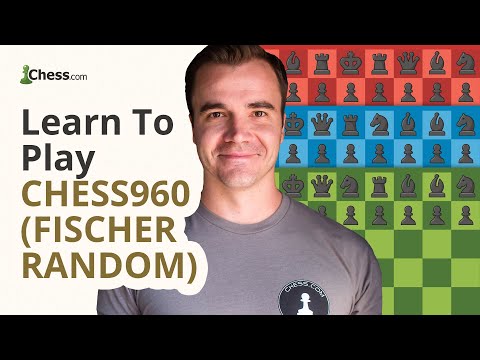
This video is embedded from YouTube and remains the intellectual property of its respective creator and/or rights holder. Vanikar LLC claims no ownership of, or rights in, the video content, and no affiliation with or endorsement by its creator is implied. The video is displayed via YouTube’s public embed feature in accordance with the YouTube Terms of Service and the agreements between YouTube and the content uploader.
📖 Detailed guide
The 960 starts
- Two conditions make a legal start: the bishops stand on opposite colors, and the king stands somewhere between the two rooks. Every arrangement that satisfies both is one of the 960.
- Both sides get the same arrangement, mirrored across the board, so neither has an edge from the draw.
- The pawns never move from their rank, so the first move is always a pawn or knight move — but which pieces it opens is new every game.
- The app numbers the arrangements as Reinhard Scharnagl did; number 518 is the chess start.
Castling, square by square
- Kingside castling ends with the king on g1 (g8) and the rook on f1 (f8); queenside with the king on c1 (c8) and the rook on d1 (d8) — the same squares as chess, whatever the start.
- The king and the rook may not have moved, and every square either of them crosses or lands on must be empty, except for each other.
- The king may not castle out of check, through an attacked square, or into one. The rook may pass through attacked squares, as in chess.
- When the king already stands on its destination, castling moves only the rook — and the other way round. Either is a legal castling move.
How a game ends
- Checkmate — the king is in check and nothing gets it out.
- Stalemate — no legal move while not in check — is a draw, as is the same position for a third time.
- Fifty moves by each side with no capture and no pawn move is a draw. There is no “insufficient material” draw: a thin ending plays on until a repetition or the count runs out.
- On a timed board, a clock that runs out loses.
Offline, online and the clock
- Offline, choose Chess960 on the chess page’s rules picker, then your color and the level. The game is kept in your browser until you end it, and Undo takes back your move and the engine’s reply.
- Online you create a Chess960 board, choose White, Black or a random draw, set a clock from one to sixty minutes — or none — and share the code or an invite link. The waiting room shows the drawn start.
- Only the clock of the side to move runs. A clock that runs out loses the game.
- Chess960 is rated and recorded as its own game, apart from chess, on the same eight boards with the same piece sets and 2D/3D switch.
🏁 How Chess960 is won
Checkmate wins. It is a draw by stalemate, by the same position arising three times, by fifty moves by each side with no capture and no pawn move, or when both sides are down to a bare king. On a timed board, a player whose clock runs out loses — only the side to move has their clock running.
❓ Chess960 — frequently asked questions
How many players do you need for Chess960?
Chess960 is played by 2. Seats you do not fill are taken by the computer, so a game always starts.
Where can I play Chess960?
In your browser at play.vanikar.games, on a computer, a tablet or a phone. Sign in with the same Vanikar™ account you use for the card games.
Is Chess960 included in my subscription?
Yes. One Card Games by Vanikar™ subscription covers the card games, Chess & Checkers and the board games, and every game released after them.
Does Chess960 have ads?
No. No Vanikar™ game has ever carried advertising, and none ever will.
How is Chess960 different from chess?
Only the start and castling. The back rank is drawn from 960 arrangements instead of always being rook, knight, bishop, queen, king, bishop, knight, rook, and castling puts the king and rook on their usual chess squares from wherever they began. Every move, every capture and every way of ending the game is the same as chess.
Do both players get the same arrangement?
Yes. White’s back rank is drawn, and Black’s mirrors it piece for piece, so the position is symmetrical when play begins.
How do I castle in Chess960?
Tap the king, then either the rook it castles with or the square the king lands on — g for kingside, c for queenside. The app marks both. The king ends on g or c and the rook on f or d, as in chess, provided neither has moved, the squares between are empty and the king does not pass through check.
Is Chess960 included in my subscription?
Yes. Chess960 is part of Chess & Checkers by Vanikar™, which a Card Games by Vanikar™ subscription includes. Play it in your browser at play.vanikar.games with the same account.