How to Play Big Two
The 2 rules — race to empty your hand.
Also known as 大老二 · Deuces · Cho Dai Di · Pusoy Dos (Philippines)
Learn Big Two: threes low, twos high, suit tie-breaks and matching combinations. Check a legal play and understand penalties for cards left.
A higher suit breaks an equal-rank tie
On a single A♣, you can play A♠ because spades outrank clubs. A single 2♦ beats either ace because rank comes before suit. A pair cannot answer a single card.
| Situation | Result |
|---|---|
| A♣ → A♠ | Legal |
| A♠ → 2♦ | Legal |
| A♣ → K♣ + K♦ | Not legal |
Suit order is ♦ < ♣ < ♥ < ♠. Save a way to regain the lead, but avoid getting caught with unused twos.
Practise this game in your browser🎯 Objective
Be the first player to get rid of all your cards.
🃏 Big Two Setup & Rules
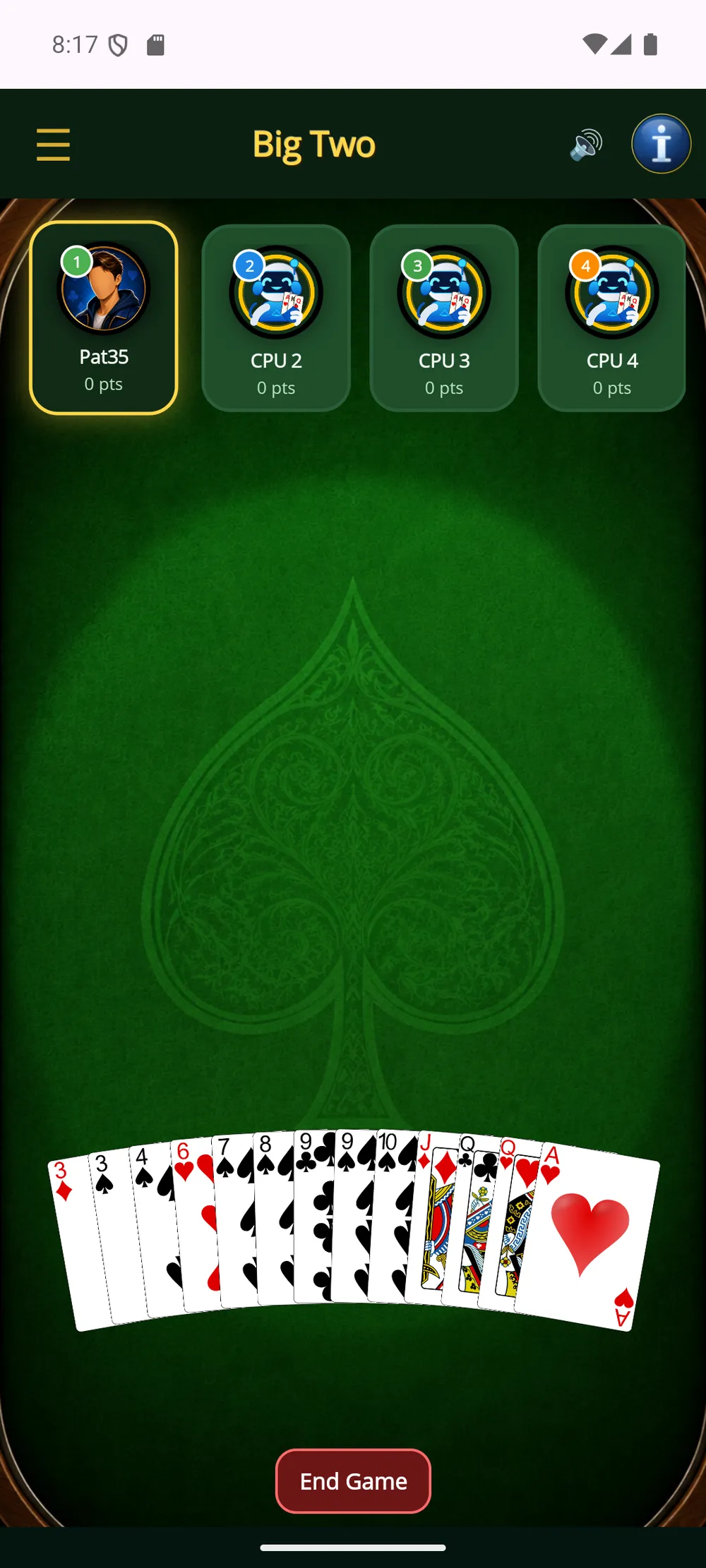
- Use a standard 52-card deck. With 4 players everyone gets 13 cards and the whole deck is dealt; with 2 or 3 players everyone gets 17 and the rest sit out.
- Card ranks (low→high): 3 4 5 6 7 8 9 10 J Q K A 2.
- Suit ranks (low→high): ♦ ♣ ♥ ♠.
- The player holding 3♦ goes first and must include it in the opening play. With 2 or 3 players some cards sit out; if the 3♦ is among them, the first seat leads with anything.
▶ How to Play Big Two
- Legal plays: single, pair, triple, or 5-card hand.
- Five-card ranks (low→high): Straight < Flush < Full House < Four-of-a-Kind < Straight Flush. A straight is five consecutive ranks in Big Two order, so J-Q-K-A-2 counts but A-2-3-4-5 and 2-3-4-5-6 do not.
- Among five-card hands a higher category always beats a lower one: a flush beats any straight, a full house any flush, and so on up to the straight flush.
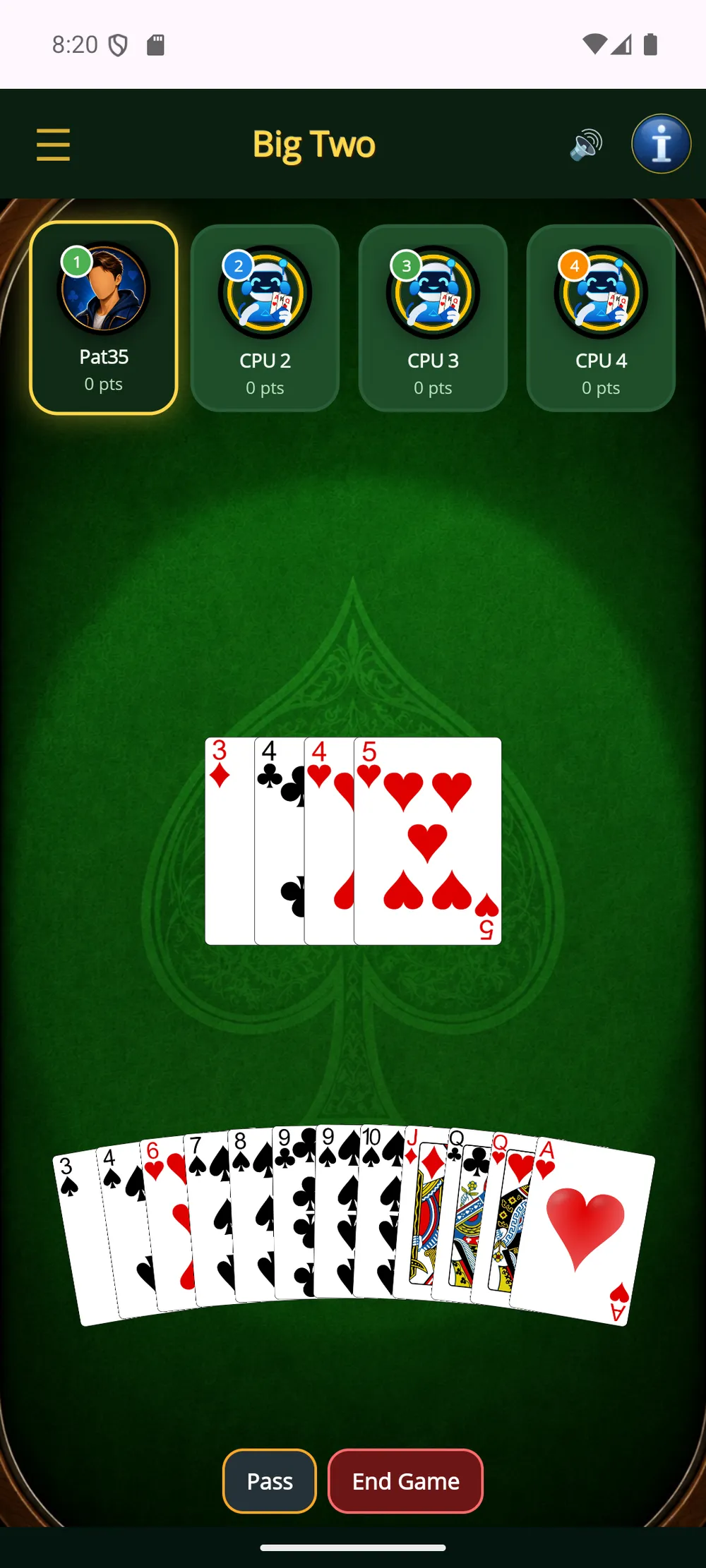
- Beat the current play with the same number of cards, or pass. For five-card plays, compare the hand categories first, then their ranks.
- When all others pass, the last player starts a fresh round with any legal combination.
🎬 Watch: How to Play Big Two

This video is embedded from YouTube and remains the intellectual property of its respective creator and/or rights holder. Vanikar LLC claims no ownership of, or rights in, the video content, and no affiliation with or endorsement by its creator is implied. The video is displayed via YouTube’s public embed feature in accordance with the YouTube Terms of Service and the agreements between YouTube and the content uploader.
📖 Detailed Guide
Setting up your table
- Big Two seats 2–4 players; with 4 players the whole deck is dealt, 13 cards each, while 2 or 3 players get 17 each.
- Remember the two rankings that make Big Two unique: card ranks run 3 (lowest) up to 2 (highest), and suits rank ♦ < ♣ < ♥ < ♠ for breaking ties.
- The player holding the 3♦ opens the game and must include it in their first play. With 2 or 3 players the undealt cards sit out, and if the 3♦ is among them the first seat opens with anything.
Legal combinations
- You can play a single card, a pair (same rank), a triple (same rank), or a five-card poker hand.
- Five-card hands rank, low to high: Straight < Flush < Full House < Four-of-a-Kind (+ kicker) < Straight Flush.
- A straight is five consecutive ranks in Big Two order (3 low, 2 high): J-Q-K-A-2 is a straight; A-2-3-4-5 and 2-3-4-5-6 are not.
- Within the same type, compare the key card: highest card in a straight, rank of the triple in a full house, and so on — suits break exact ties.
Beating the current play
- Each play must beat the previous one using the SAME shape: a pair over a pair, a single over a single, a five-card hand over a five-card hand.
- Among five-card hands a higher category always beats a lower one whatever the cards: a flush beats any straight, a full house any flush, and so on. There are no bombs — a five-card hand never answers a single, pair or triple.
- Can't (or don't want to) beat it? Pass. Passing doesn't lock you out of later turns in the same round.
- When everyone else passes in a row, the pile clears and the last player to play starts a completely fresh lead with anything they like.
Ending a hand and penalties
- First player to shed all their cards wins the hand; remaining players are penalized per card left.
- Penalties escalate: 10–12 cards left counts double, and being caught with all 13 counts triple — never sit on a full hand hoping for perfect plays.
- A single two can only be beaten by a higher-suit two under these rules. Do not mix in bomb rules from other climbing games.
📊 Big Two Scoring
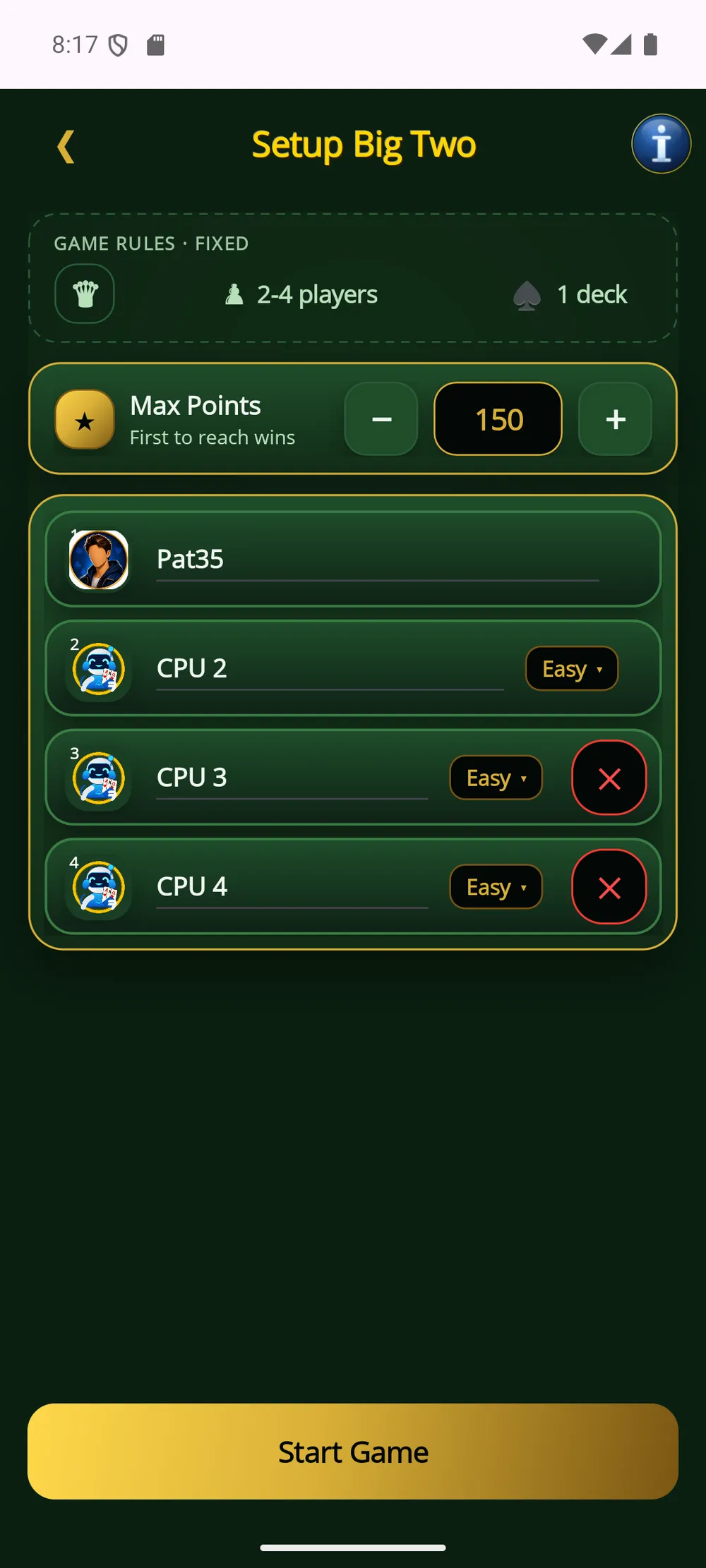
Cards remaining = penalty. 13 cards = ×3 penalty; 10–12 cards = ×2. Penalties add up across hands; the match ends when someone reaches the Max Points target (150 unless you change it at setup, 100 to 200) and the lowest total wins.
❓ Big Two — Frequently Asked Questions
How many players do you need for Big Two?
Big Two is played with 2–4 players. On Vanikar, empty seats can be filled with AI opponents so you can always start a game.
Who plays first in Big Two?
The player holding the 3 of diamonds leads the first trick and must include it in the play. After that the winner of each trick leads whatever combination they like.
What five-card hands can you play in Big Two?
Straight, flush, full house, four of a kind with a kicker, and straight flush, from weakest to strongest. A five-card play may only be beaten by a stronger five-card play.
How are suits ranked in Big Two?
Diamonds lowest, then clubs, hearts and spades highest. Between two cards of the same rank the suit decides, so the 2 of spades is the highest card in the deck.
How is Big Two scored?
When one player goes out, everyone else counts their cards as penalty points: 13 cards count triple, 10 to 12 double. Penalties add up across hands until someone reaches the target, 150 by default, and the lowest total wins.
📱 Big Two in the app
A step-by-step look at a real game on the table.